This news release from the city, asking for suggestions for locations for bike-share docks, seems like fertile ground for fun. I do know other cities have had some mini-wars over the location of docks. Personally, I am lobbying for one directly in front of my house. I know others won’t feel the same.
Suggest a station site for public bike share
Anyone who lives, works or plays in and around downtown Vancouver is invited to suggest a station site for Vancouver’s new public bike share system.
“Public bike share will be a big boost for Vancouver’s active transportation system,” said Mayor Gregor Robertson. “This is a great opportunity for people to have their say for where bikes are most needed for short trips and to help us fill the gaps in our existing network.”
The launch of the public bike share system this summer will include 1,000 bicycles and 100 stations. An additional 500 bikes and 50 stations will be added by the end of summer 2016. The initial service area will include the Downtown Peninsula, bounded by Arbutus Street, 16th Avenue and Main Street.
Public bike share stations will be located at popular destinations near where people work, study, shop, dine and play. Stations will be spaced every two to three blocks on streets, sidewalks, plazas, parks and private property within the service area.
“We are actively inviting input from Vancouver residents and commuters on station sites,” said Mia Kohout, General Manager of Vancouver Bike Share Inc, the Vancouver subsidiary of CycleHop. “People can simply go to vancouverbikeshare.ca and pin a location on the map to make their suggestions.”
People can also suggest a public bike share station site using the City’s VanConnect app – look for Cycling in Vancouver/Suggest a Location.
Businesses or property owners wishing to request a station on their property can email CycleHop directly at [email protected]<mailto:[email protected]>.
Vancouver’s public bike share system will be the largest smart bike fleet in North America, featuring ‘a brain on the bike’ that allows users to unlock and activate easily and quickly. This allows for increased flexibility of station configuration and placement; stations can also be easily relocated in response to demand.
The City announced in February that CycleHop, a privately-owned company, had been selected to operate a public bike share system that is expected to roll out in downtown Vancouver starting summer 2016.
Overall, the City has seen a continued year-over-year increase in the use of its bike lanes as more residents adapt to cycling, in part due to infrastructure built for people of all ages and abilities. The majority of trips in Vancouver are now taken by foot, bike, or public transit. To view monthly stats visit: http://vancouver.ca/files/cov/Bike-lane-stats-by-month.pdf.
Tags: Uncategorized
Vancouver is gearing up this week to deal with Airbnb, with Councillor Geoff Meggs spearheading a motion to have staff get more aggressive about getting information from the company and about getting information on the impacts.
It’s a popular move for many. Landlords, strata councils, neighbours, housing advocates and more are all worried about the impact of having all residential areas turning into scattered hotel sites.
But there are also local Airbnb hosts who are worried about an impending crackdown, saying that what they’re doing doesn’t take away renter housing and that it adds life and a financial benefit to their communities. Those who only rent a spare bedroom or who only rent out their places while they are out of town especially feel strongly that they are providing a benefit that doesn’t take away from the local housing stock.
Their story here.
Tags: Uncategorized
Vancouver’s Mount Pleasant industrial area is undergoing a profound transformation.
For years, the old steel-plating, gadget-manufacturing, and garment-producing businesses had been leaving slowly.
But that speeded up three years ago when two things happened. Hootsuite, the city’s bigfoot digital company, moved into a building in the area. (It was a building zoned for office use, at 8th and Quebec, across the street from the conventional industrial zone.)
And the city tweaked the zoning to allow some office uses, as long as one floor of a building was retained for industrial.
Tech companies started to flood in and prices went up.
My story last weekend looked at the changes and the struggle going on in the city, and the region, to figure out what industrial actually means these days and how to keep office users looking for cheap space from invading.
In Vancouver, where council is particularly anxious to foster a tech industry, the debate is even more pointed.
Tags: Uncategorized
So interesting to see how the ground is shifting on this issue of Airbnb.
When I first wrote about the phenomenon in Vancouver four years ago (inspired by rumblings of dissatisfaction I’d been hearing in other cities), there didn’t seem to be a lot of concern.
The bed-and-breakfast people weren’t so happy, but the hotel association was staying out of the fight and it didn’t seem to be on a lot of people’s radar. My main problem with the story was finding an Airbnber to talk to me, I presume since many of them are breaking several kinds of bylaws or strata rules or CRA reporting requirements.
Fast forward, and we get to this week, where council is now pushing hard to get maximum information in order to figure out what to do. The number of listings in Vancouver has increased to almost 5,000.
It’s not just this council that’s worried. Others are too, along with landlords (I talked to an apartment manager in my story whose sign in front of the building specifies “No Airbnb) and strata councils, which have been rapidly moving to create new bylaws that prohibit Airbnb rentals.
At the same time, it’s not a black and white issue. I, like many in this city, have used Airbnb elsewhere because of the chance it gives to feel like you’re living in a real apartment in a regular neighbourhood. I try hard to stay at places that don’t appear to be set up as permanent hotels. I’m not always successful, but I do try. My best experience was a gorgeous place in Lyon I rented from a flight attendant who was in Iceland during our four days there.
I’ve also been contacted, since I wrote the story, about people who say they’re concerned that there will be a crackdown on the kind of Airbnb rentals they do that they believe help provide needed spaces for visitors, but don’t take away long-term housing — people who rent out a spare room or who rent out their whole places if they are away for a few weeks or months on vacation or business.
I understand there’s been divided opinion at the city’s rental advisory committee, because some representatives there say it helps renters if they can have someone stay a few nights a month to help them make the rent.
And a UBC student has also written about the issue of people who are renting out a spare room.
On the other hand, there are indeed whole units being lost to the “hotel” market. I wrote about last year about a couple who said they decided to Airbnb their basement because the tenant was moving out. I later heard from the tenant that she’d been told they were planning to do that, so she decided to leave without a fight.
That’s a problem when, as anyone looking for rentals these days knows, it’s a near-zero vacancy rate and there are 100 applications for any available unit that isn’t a slum.
Tags: Uncategorized
Oh brother, economists doing calculations on the backs of envelopes to throw another Douglas fir on the bonfire of Vancouver real-estate hysteria. Isn’t there some kind of Hippocratic oath about doing no harm?
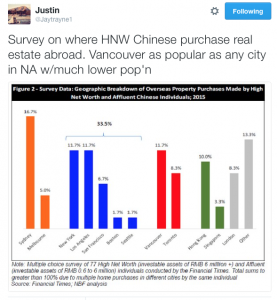
Anyway, for those who didn’t see it, some bank economists put a few numbers together to declare that a third of all Vancouver real estate was bought by high-net-worth Chinese investors last year. The story has quickly spread, with various levels of helpful information about how they calculated the numbers. Story 1 from Bloomberg here, story 2 from the Globe, and story 3 from the Vancouver Sun. The bar graph below also appeared in my Twitter feed, not sure from from where.
And it’s sure to attract some analysis. As alert readers will note, this comes from a sample of 77 high-net-worth Chinese investors who agreed to answer a survey saying where they had bought property. The Sun story spells out that that could mean offshore investors or residents and immigrants to the country. Since 11 per cent of them said Vancouver was their real-estate choice, that would mean nine of the 77. Nine.
Then the economist calculations pegged their purchases at $12B Canadian, I guess by dividing the total amount of presumed sales around the world to Chinese people by 77, and concluded that these nine people’s answers could be extrapolated to say that one-third of the total sales in Vancouver’s market last year were to high net worth Chinese buyers. But a quick check shows that that the $38.5 billion they’re referring to is the number for residential resales for the Real Estate Board of Greater Vancouver. So that’s not the total in sales for the Lower Mainland. About 10 to 15 per cent of sales (developers selling their own condos, etc.) happen outside the board’s MLS system. It also doesn’t include the $11 billion in sales from the Fraser Valley real-estate board, which includes Surrey, Delta and Langley, or the 10 to 15 per cent of non-MLS sales there.
But, whatever, one more factoid for the mill.
Additional note an hour later: Alert Twitter observers have noted it’s one-third of dollar value, not one-third of units. If rich folks are buying very expensive places, they could well be buying much less than a third of everything that sold. A further note: Joanne Lee-Young’s story in the Sun has the best explanation for the methodology the economists used, something about guesstimating the level of buying in Canada based on levels of buying in the States. (Just read it, I couldn’t possibly summarize the contortions.)
Tags: Uncategorized
An exciting week for local government types, as they waited for the announcement on the details in the federal budget about what on their wish list would be getting deliveries from the money pipeline.
What I’m finding interesting about it, as a few days have gone by since budget day, is how much is still being hashed out and explained about what projects exactly will get the money, which parts of projects are eligible (design and planning for transit never used to be eligible for federal funds, now they are), and all kinds of other wiggly things.
My guess is there is a lot going on between the federal people and the provincial people to get them to come on board with certain projects in exchange for guarantees of money on others. At the moment, the city people and the feds are working together. It was clear when I was talking to mayors and councillors that they feel like they have a direct pipeline and are no longer left guessing and begging. It’s the province that seems to be the recalcitrant, left-out one.
Stories here and here from day before and day of budget.
Tags: Uncategorized
City council has taken a lot of flak for negotiating deals with developers to do all-rental buildings but letting them charge market, i.e. going-rate rents.
Now, with this new Concert Properties building going up next to the Olympic Village, the city has negotiated a deal that means it gets 135 units in the 600-unit development and it will ensure that at least 40 per cent of the units are below market. Story here.
I asked the city’s housing officer, Mukhtar Latif, why the city can’t do that in the Rental 100 buildings. He said that there isn’t the same kind of land lift in those developments. The city can get an agreement that they’ll be rental by reducing fees and parking requirements and adding some density. But not an agreement to hold the rents to below market.
I’m told the rents for the 40 per cent segment will be $915 for a studio and $1,480 for a three-bedroom for people with qualifying incomes, i.e. below $56,000. (I know those numbers are different from others reported out of a news conference but that’s what was in the chart sent to me later.)
Then the other units will be held to rates for the average in the area, so $900 to $2,000 in the same spread. One of my Twitter commenters expressed disbelief that anyone could find any three-bedroom in the city for $2,000, but that’s what they told me, folks. We’ll see when the building is finished in mid-2018 — just in the for the election campaign!!
Tags: Uncategorized
One of the fun parts of my job is getting to talk to architects when they are really excited about a project. That was the case when I went down to see Mark Whitehead and Mark Thompson explain the plans they’ve developed for the old Canada Post building.
They clearly loved solving the puzzle of how to re-use such a huge building (115,000 square feet per floor) and how it could be re-designed to make it a people-activity generator. One of their ideas: create a set of steps along the sloped front of the building on Georgia Street and turn it into the kind of hangout place that has developed on the south-facing steps of the central library, but with even more attractions – some wooden seats built into the steps, plantings, a water feature.
It was also kind of relief to hear about a project where the owner is planning for almost three-quarters of the units to be rentals, without city incentives. Just because pension funds like rental buildings for the income stream.
More details in my story here.
Tags: Uncategorized
So, as has become the tradition in Vancouver, whenever data (or even fragmentary information) on the very contentious issue of real estate and foreign investment is published, it sets off an energetic debate with people piling on to outright refute it or pick holes or challenge the interpretation.
This one is no exception and there was even more of this, in an atmosphere that has grown weirdly ever more polarized and vitriolic.
The critics this time jumped on “the media’s” use of the word “myth” in some stories and on various problems they believe they have spotted in the Ecotagious study that was done for Vancouver. That study, for the uninitiated, looked at 12 years worth of BC Hydro electricity-use data for 225,000 homes in the city, using various techniques to try to get around issues like automated light/heat switches, occasional visits by caretakers turning things off and on, and other factors that might give false positives to the question of whether the home was occupied.
It found that the overall city vacancy rate of about 4.8 per cent hasn’t changed from 2002 to 2014, that the rate within five large geographic sectors hasn’t changed, except that the downtown has dropped to about six per cent, and that the vast majority of the 10,300 units that are empty are condos (about 9,700).
I’ll take a look at the methodology questions in a bit, since all of us were still trying to understand them long after our publication deadlines had passed and new questions were being raised with every passing hour.
But first, I wanted to examine the issue of why almost every media outlet made a point of contrasting the study’s results with “public myths” or “prevailing public opinion” or “popular perceptions.” (I’ve attached at the bottom here a selection of the wordings used by various major outlets.)
As I said to my journalism classes, this study’s results didn’t make sense to readers unless they were put in context. And that context is the prevailing narrative in Vancouver that foreign investors are buying a significant portion of the city’s housing stock, that they’re leaving it empty, and that they’re contributing to the city’s unaffordability and/or unlivably low vacancy rate in some way as a result.
[Read more →]
Tags: Uncategorized
The city’s release of a comprehensive study of 12 years worth of electricity use in 225,000 homes has given the most detailed picture to date, in 20 years of arguing, about what is empty in Vancouver and what isn’t.
And it has all gone to prove my newly devised Bula’s theorem: The more data there is, the more disagreement. Data, rather than settling anything, seems to generate new battles on ever more fronts. (Australia has proven that. It collects data on foreign ownership that many people here say is needed. Every time the state issues a report, there is a torrent of people saying the numbers must be wrong, that ownership is really higher than the 15 per cent or whatever, because people are cheating, that the numbers don’t really take into account this or that.)
Anyway, the report is out. It provides data for some interesting things but not others. Since electrical use isn’t combined with any kind of home ownership information, it doesn’t really say anything about foreign ownership or foreign capital or what role investors play or why units are empty.
As staff said yesterday, it showed that vacancy is not correlated with real-estate prices. It showed there were 10,800 units that had been empty for at least 12 months in 2014, which is 2,400 more than in 2002. The rate of overall vacancy hasn’t changed (about 4.8 per cent) but, since there is more housing in Vancouver now than in 2002, the absolute number of units unoccupied has increased.
No one knows why they’re vacant. It’s mostly condos that are vacant, about 9,700 of the total (I’m working on a story as we speak about what might be the cause of that).
And that’s where we are. My story here. The city’s power point here and the consultant’s report here, for those wanting to do a little Talmudic deconstruction.
Tags: Uncategorized
